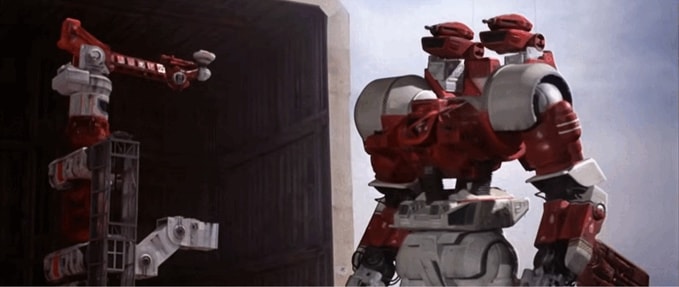

Let’s define some terms. For our purposes, a mech is a giant robot that is controlled by a human pilot who rides in a cockpit within the machine itself. Legendary manga artist Go Nagai is credited with creating the first instance of a giant robot piloted from within in his 1972 manga Mazinger Z. Earlier iterations, such as Mitsuteru Yokoyama’s Tetsujin-28 and Giant Robo, involved young people guiding giant “super robots” via remote or radio controls.
Over time, these spawned an entire genre of imitators and successors, from Mobile Suit Gundam to Macross, Vision of Escaflowne to Neon Genesis Evangelion, with plenty of stops in-between. As popular as the various manga, anime, and video games surrounding these stories were, an equally popular hobby of building mecha model kits sprang up, and today, Gundam kits are likely built by people who have never watched so much as an episode of any of the shows, and never will.
Some of these series also provided inspiration for popular American toys and cartoons, such as Transformers, Shogun Warriors, Voltron, and others. The Power Rangers series—themselves repurposed from Japanese Super Sentai shows—also feature piloted mechs that, like those in Voltron, can combine to form a larger version.
It’s impossible to accurately discuss the history of combat mechs without touching on BattleTech, a wargaming and military sci-fi franchise originally launched in 1984, and still played on tabletops all over the world. Though it never had an official live-action movie, BattleTech did launch an animated series, roleplaying and video games, a collectible card game, and more than a hundred novels, to name just a few.
Regardless of their origins, many of these various franchises gave rise to live-action tokusatsu (a Japanese term for movies and TV that rely heavily on special effects) shows in Japan and sometimes even in the States, but there have been surprisingly few live-action mecha movies, despite the genre’s massive popularity.
You might be able to chalk at least some of that up to the considerable expense involved in such a gargantuan undertaking. There have been a few, however, among them these five movies (and their various spin-offs, sequels, and so on) that are required viewing for fans of sci-fi featuring combat mechs!
Pacific Rim (2013)
Guillermo del Toro pulled from a huge variety of anime and tokusatsu sources to create his love letter to kaiju and combat mechs. Called Jaegers, the massive mecha in Pacific Rim are controlled by not one but two pilots, who work in unison and share the neural load through a mental link called the Drift. Praised by the likes of William Gibson, Go Nagai, and Hideo Kojima, Pacific Rim’s success spawned fan conventions, a sequel (Pacific Rim: Uprising in 2018), comic books, an animated series (Pacific Rim: The Black), and both a roleplaying game and miniatures-based tabletop game, not to mention the expected action figures, video games, and so on.
Robot Jox (1989)
Famed horror director Stuart Gordon (Re-Animator; From Beyond; etc.) helms what turned out to be the most expensive and most ambitious movie ever produced by Charles Bands Empire Pictures—and also one of the earliest live-action movies to feature piloted combat mechs. As such, Robot Jox has been called “the Battletech movie we never got,” and it went on to influence a lot of what came after, including Pacific Rim.
The mechs here are brought to life by stop-motion effects master Dave Allen, while the screenplay comes from famed sci-fi author Joe Haldeman (The Forever War)—who apparently had a very different idea of what the finished movie should look like. Robot Jox spawned two mostly unrelated semi-sequels, 1990’s Crash and Burn, which has less to do with mechs and is more like And Then There Were None with a cyborg, and 1993’s Robot Wars.
Gunhed (1989)
The same year that Robot Jox was hitting theater screens in the States, Japan produced a notorious apocalyptic cyberpunk film featuring combat mechs going up against Bio Droids and an evil AI. Gunhed allegedly influenced the visual design of Final Fantasy VII, and its mechs were created by the legendary Shoji Kawamori, who worked on everything from Macross to the toy line that inspired Transformers.
Kawamori would later utilize similar designs to the ones he created for Gunhed in his popular Armored Core series. His designs were brought to life by special effects director Koichi Kawakita, who had previously worked on Ultraman and went on to do special effects for pretty much all of the movies in Godzilla’s Heisei era.
Godzilla Against Mechagodzilla (2002)
Speaking of Godzilla, as early as Godzilla vs. Mechagodzilla II (1993), Mechagodzilla—as its name implies, a giant mech made in the image of Godzilla—is piloted by humans, but the real combat mech action takes place in 2002’s Godzilla Against Mechagodzilla and its follow-up, Tokyo S.O.S. Here, Mechagodzilla is known as Kiryu, and is a combat mech built around the skeleton of the original Godzilla from 1954.
Showcasing a classic element of many mech stories, Kiryu requires a human pilot but also, thanks to the incorporation of Godzilla’s skeletal remains, has a mind of its own, sometimes overriding its pilot’s wishes or acting on its own volition—and once going berserk to attack Tokyo, of course.
G-Saviour (1999)
Perhaps no other franchise is as unfalteringly associated with combat mechs as Gundam. Beginning with the original Mobile Suit Gundam in 1979, the series spawned a seemingly endless cascade of anime, model kits, toys, video games, and more. Surprisingly, however, there has been only a single live-action Gundam movie—a notorious 1999 film shot in Canada and made as an American-Japanese co-production to celebrate the franchise’s 20th anniversary.
The result has been called everything from “a pleasing mix of both science fiction and adventure” (by Anime News Network) to an “absolute disaster” by many fans. It doesn’t seem to have marred anyone’s enthusiasm for Gundam, however, which remains one of the most popular mecha franchises in the world.
Featured image: Universal Pictures / YouTube


