

What is science fiction? The Merriam-Webster Dictionary defines it as “fiction dealing principally with the impact of actual or imagined science on society or individuals or having a scientific factor as an essential orienting component.” Which is not too far off from what Cory Doctorow said in a speech as part of the University of Washington’s “Neuroscience, AI and Society” lecture series.
“I’m a science fiction writer,” Doctorow said, “which means that my job is to make up futuristic parables about our current techno-social arrangements to interrogate not just what a gadget does, but who it does it for, and who it does it to.”
That seems to be a pretty succinct summary of both what a science fiction writer does and what a sci-fi novel is. Go back a little over a hundred years, though, and a science fiction writer would have been as speculative a term as anything they might write about. Most of our modern fiction genres are byproducts of marketing impulses, and they didn’t really solidify into their current shapes until the early part of the 20th century. Before that, while people may have been writing sci-fi, they wouldn’t have called it that, or thought of that as what they were doing.
Returning to Merriam-Webster, they say that the earliest known use of the phrase science fiction in its modern sense dates back to 1898, which happens to also be the year that H. G. Wells first published The War of the Worlds in book form. Again, science fiction books were certainly being written before then—you’ll find a few of them on this list—they were just called something else. So, what are some of the other titles that can help you to understand what a science fiction book is and does? We’re glad you asked…
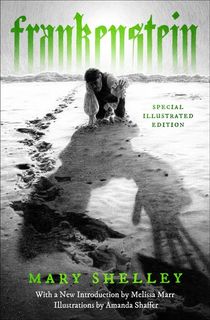
Frankenstein
Lots of people will tell you that Mary Shelley invented science fiction when she first (anonymously) published Frankenstein in 1818. She probably didn’t, given that numerous works meeting our definition of sci-fi up above had been published before. What she did do, however, was create a sensation, using then-recent scientific advances as an inspirational jumping off point to give us one of our most enduring modern myths.
A hundred archetypes are born in the pages of Mary Shelley’s novel, and every story about mad science and men playing God owes at least a little something to it—not to mention that it has been adapted to film more than almost any other work of fiction over the years, including a recent Oscar-winning version from Guillermo del Toro.
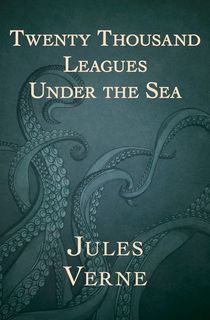
Twenty Thousand Leagues Under the Sea

Along with H. G. Wells, French writer Jules Verne is often considered one of the fathers of modern science fiction, thanks to his speculative adventure books such as Journey to the Center of the Earth, From the Earth to the Moon, and Around the World in Eighty Days, among many others. Of these, perhaps none is more famous than this story of nautical adventure from 1870, which features, among other things, a stunningly accurate early portrayal of submarine technology.
Many of Verne’s stories inspired some of the earliest science fiction films, and Twenty Thousand Leagues is no exception, with the first known silent film adaptation dating all the way back to 1905.
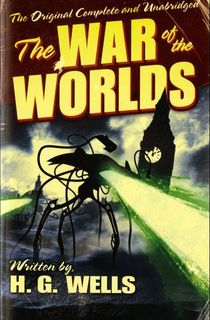
The War of the Worlds
As we already mentioned, Merriam-Webster cites 1898 as the first year that the phrase science fiction was used as a genre term, and that was also the year that H. G. Wells published one of his most famous works in book form (it had previously been serialized in Pearson’s Magazine and Cosmopolitan).
There can be few more defining science fiction titles than War of the Worlds, an early example of a story of mass conflict between the people of Earth and an invading extraterrestrial species, one that set up many of our expectations of what an alien invasion might look like. Already a hit as a novel, War of the Worlds achieved even greater notoriety in 1938, when a Halloween episode of The Mercury Theatre on the Air adapted Wells’s novel to radio, narrated by Orson Welles—and convinced at least some people listening at home that a Martian invasion was really taking place.

A Clockwork Orange
One of the most popular types of science fiction in the contemporary world is the dystopian novel – make of that what you will. Dystopian fiction has several iconic exemplars, including George Orwell’s Nineteen Eighty-Four, Aldous Huxley’s Brave New World, Ray Bradbury’s Fahrenheit 451, and Margaret Atwood’s The Handmaid’s Tale, to name a few.
To those, add this 1962 novel of juvenile delinquency and government coercion from British author and composer Anthony Burgess, adapted into a notorious 1971 film by Stanley Kubrick, which certainly fits Doctorow’s definition of examining “who it does it for, and who it does it to.” Despite the novel being frequently banned and challenged in the U.S. and elsewhere, it has also been included in countless “must read” lists, including being named one of the “100 best English-language novels of the 20th century” by Modern Library.
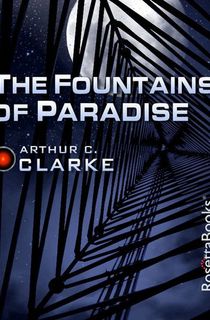
The Fountains of Paradise
The so-called “Golden Age of Science Fiction” began in the 1930s, when pulp magazines started publishing stories that dealt with more “realistic” science fiction. John W. Campbell, who took over as editor of Astounding Stories in 1937, allegedly gave his writers this remit: “Write a story that could be published as a contemporary tale in a magazine published in the 25th century.”
Among the writers who came out of science fiction’s “Golden Age,” one of the most celebrated is Arthur C. Clarke, whose work will be familiar even to the uninitiated thanks to Stanley Kubrick’s 1968 film version of 2001: A Space Odyssey. The Fountains of Paradise may not be as well known as some of Clarke’s other works, but this Hugo and Nebula Award-winning 1979 novel is a representative one, dealing with the construction of a massive “space elevator.”
Featured image: Nader Saremi / Unsplash


