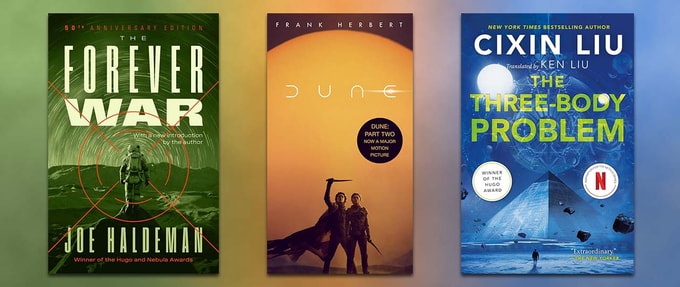
Science fiction has been around since before the myth of Icarus, although it was following the Industrial Revolution and the popularization of the novel as a literary form, that the genre slowly came to its own. In the last century alone, the field has evolved by leaps and bounds, giving birth to subgenres from cyberpunk to climate fiction and welcoming more diverse authors to the fold, even as it engages with our ever-changing reality, shaped by scientific and technological progress and the cogs of capitalism.
One of the exciting aspects of science fiction is that it speculates about the best and worst possible outcomes of any situation—from utopian solarpunk communities that have found sustainable ways to combat climate change to dystopian hellscapes, where everything from resources to manual labor is exploited for profit to line the pockets of billionaires. So whether you’re new to the genre and planning to catch up on the classics, or you’re looking for a refreshing and thought-provoking read, we’ve curated a sci-fi reading list, cherry-picking the best books from each decade.
From popular bestsellers to underrated gems, there’s a science fiction classic for everyone!
1920s

R.U.R.
Our first item on this list is a rather special one. R.U.R. (short for “Rossum's Universal Robots”) is actually a sci-fi play by Czech writer Karel Čapek that introduces the word “robot” to the English language and the genre! In this play, robots are artificial workers created in a factory and made to serve humans, and while they don’t have original thoughts, they can actually pass for human.
A century since its publication, we've entered an age where generative AI is all the rage. Čapek’s eerily prescient play remains relevant as ever, imagining what artificial life can look like, and envisioning the profit-driven circumstances that engineer their creation in the first place.

1930s
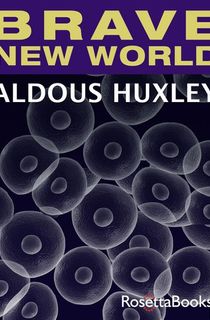

Brave New World

Huxley’s Brave New World is a great entry point for anyone curious about dystopian fiction, imagining a world where citizens are segregated by an intelligence-based hierarchy, with very little agency. As fascist dictatorships are on the rise in various parts of the world, Brave New World reminds readers that a state that seeks to control its people doesn’t have their best interests at heart.

1940s
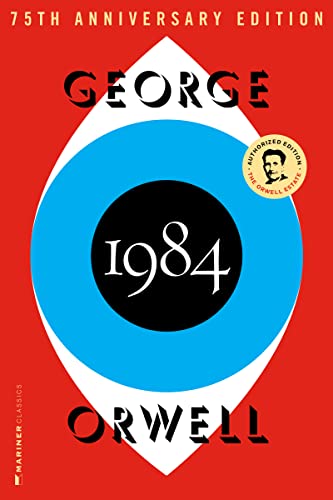
1984
Another powerfully convincing dystopia, George Orwell’s 1984 is also a timely read. With a few deft strokes, Orwell paints a vividly-realized world with its complex set of politics, economics and “anti-language” for that matter that will definitely give you chills as you read it. Given the rise in censorship and discrimination everywhere, 1984 is the perfect thought-provoking read for this age.
1950s
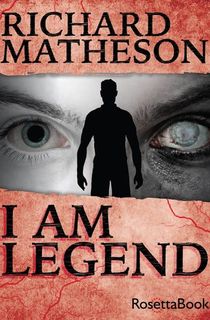
I Am Legend
Zombie fiction is now a whole genre on its own and since the COVID pandemic, there have been several sci-fi books that depict fictional pandemics. But a book that sort of does both many years earlier is Richard Matheson’s I Am Legend. It imagines a post-apocalyptic world where much of the population has died due to an infectious disease while the rest have succumbed into becoming vampire-like creatures. A lone scientist, Neville sets out to investigate a scientific cause for the origin of these vampires, even as he fends off several dangerous attacks from the monsters and risks his life numerous times.
1960s

Dune
Herbert’s Dune is a masterclass in worldbuilding. Originally serialized in Analog magazine, much of the narrative explores a feudal interstellar society, vying for the “spice” in the desert planet of Arrakis. As different factions struggle for the control of the planet, the readers get a glimpse into the detailed worldbuilding that takes into account religion, ecology, sociology, technology, and of course, politics, as the backdrop to an epic, generation-spanning adventure. Now ambitiously adapted for the big screen by Denis Villeneuve, Dune and its sequels are worth multiple rereads.

1970s
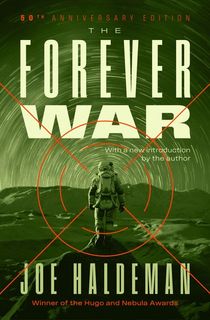
The Forever War
This meditative Joe Haldeman book is a military SF novel wherein humanity has been engaged in an epic interstellar war against aliens called Taurans for a long while. The novel has an autobiographical element to it—the author having served in the Vietnam War—which makes its anti-war themes all the more pronounced.
1980s

Neuromancer
Gibson’s Neuromancer is gritty and enticing. It not only gave birth to the cyberpunk genre but also anticipated the arrival of the internet. All the speculative stuff Gibson writes about may seem commonplace now, which only proves how so many of science fiction’s predictions come true—in ways that are both good and bad.

1990s

Red Mars
Part of the Mars trilogy, Red Mars is an epic story of colonizing and terraforming the red planet for human habitation. Told through multiple viewpoints spanning generations and drawing upon diverse disciplines, Red Mars is meticulously researched and convincingly written, offering a highly immersive reading experience.

2000s

Stories of Your Life and Others
This one’s the only short story collection on this list, though it also contains the titular novella (adapted into the critically acclaimed Arrival) among several other thought-provoking tales. Indeed, every short story that Chiang writes is a gem—a mini thought-experiment of sorts—that encourages the reader to see the world from a new perspective. A personal favorite is “Liking What You See: A Documentary”—a short story written as a script that explores pretty privilege and beauty standards in a gripping way.

2010s
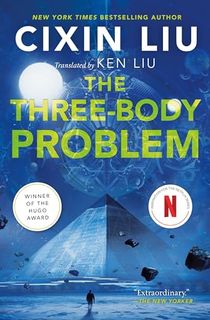
The Three-Body Problem
This hard sci-fi novel is the first in a trilogy and explores Earth’s civilization encountering aliens. With a diverse cast of characters and a well-placed plot filled with twists and turns, the narrative of The Three-Body Problem is best experienced without any spoilers. And if you enjoy it, you can also tune in to the Netflix adaptation whose second season is slated to air soon.

2020s
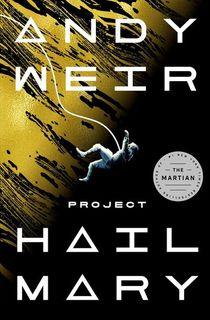
Project Hail Mary
Finally, the last book on this list is a fun ride that really gets into the heart of what science fiction is all about—exploring the unknown and using human ingenuity (with the aid of technology) to solve problems. This book is essentially a lone man’s journey to save his planet and his first encounter with an alien race that manages to be heart-warming, engrossing and utterly hilarious at the same time. And the best part is that all the science-y elements in it are very plausible and also pretty accessible. Now turned into a major motion picture starring Ryan Gosling, Project Hail Mary is a light and exciting read that will fill you with hope and wonder.


