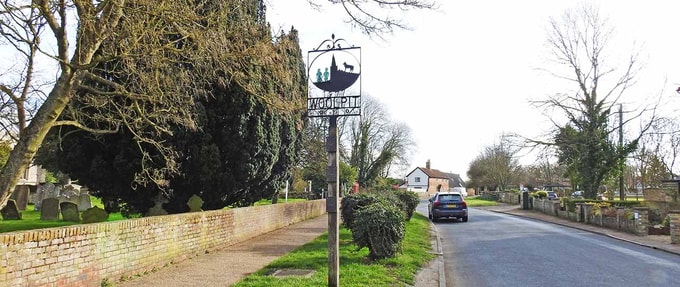

While there are no shortage of accounts regarding the Green Children of Woolpit, the important bits remain the same.
According to the stories, in the 12th century of Suffolk, England, two children appeared near the wolf pits from which Woolpit took its name. Their skin was green. They spoke a language nobody understood. They refused every kind of food except broad beans. The boy later died, while the girl survived, learned English, was baptized, and eventually married.
Only then was she able to describe where they believed they had come from. She spoke of a place called St. Martin's Land, where everyone was green and daylight was never as bright as it was in England.
Modern retellings about the Green Children of Woolpit often speak of fairies, hidden worlds, or the paranormal, but the original stories from Ralph of Coggeshall and William of Newburgh simply record an unusual event. Their matter-of-fact tone is striking, as is the curious detail about the broad beans. Dramatic legends often grow over time, but small, everyday details can feel as though they've survived because somebody genuinely remembered them.
What sort of world produced this story?
Twelfth-century East Anglia was one of England's great wool-producing regions. Across the North Sea, the weaving towns of the Low Countries depended heavily upon English wool. Trade crossed the English Channel constantly, bringing merchants, craftsmen, and their families as well as cargo.
Some experts such as Paul Harris in his 1998 work, “The Green Children of Woolpit: A 12th Century Mystery and its Possible Solution,” believe the children were really Flemish immigrants. Two foreign children, dressed differently and speaking an unfamiliar language, would have attracted attention wherever they appeared. Long before anyone commented on the color of their skin, they would already have seemed extraordinary.
The Flemish connection fits the landscape, the economy and the movement of people through medieval East Anglia better than many of the more sensational alternatives.
However, it still leaves obvious questions.
Why were the Children of Woolpit described as green?
Historians have suggested illness, poor nutrition and other possibilities over the years, but none provides a completely satisfying answer.
The description of St. Martin's Land remains equally elusive. Perhaps it refers to a real place remembered imperfectly. Perhaps the story already changed before it reached early chroniclers like Ralph of Coggeshall and William of Newburgh.
Why does the mystery endure today?
Some stories survive because they refuse to fit neatly into a single explanation, and the Green Children of Woolpit may be one of them.
Visiting Woolpit certainly offers few answers. On my visit to the Suffolk village, there were very few references to the Green Children. Woolpit seemed content simply to accept its story and get on with life. However, if you're interested in learning more about this fascinating story, here are a few works we'd recommend.
Further Reading
- Ralph of Coggeshall, Chronicon Anglicanum
- William of Newburgh, Historia Rerum Anglicarum
- Francis Young, The Green Children of Woolpit: Chronicles, Fairies and Facts
- Robert Bartlett, England Under the Norman and Angevin Kings
- Reader's Digest, Folklore, Myths and Legends of Britain


