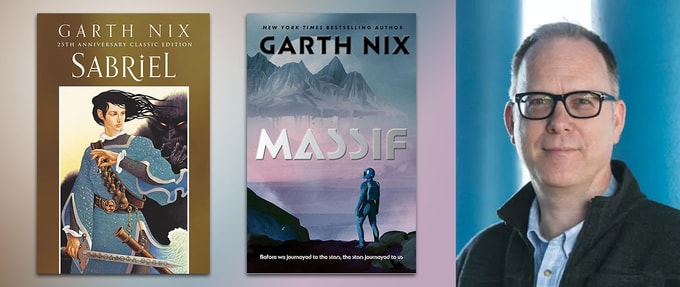

Garth Nix has had an impressively wide-ranging career in publishing. Aside from being an award-winning author, he’s worked as an editor, a marketing consultant, and even a literary agent. His first book, The Ragwitch, was published in 1990. He has since penned over 40 books in various genres, ranging from picture books to adult fiction.
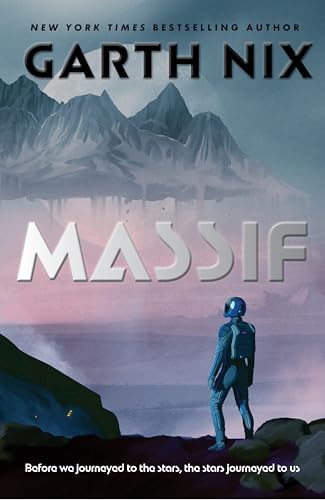
His most recent work, Massif (published on September 8), is an adult science fiction novel where sentient mountains called Massifs transport humanity through the galaxies. No one is supposed to ask what the Massifs are or why they carry humans through the stars. But to save one of their own, the Massifs will break those rules and more. And maybe, they’ll accidentally save all of mankind while they’re at it.
I was delighted to sit down with Nix, where I learned that The Lord of the Rings was imprinted on him in utero, how his own military experience shaped this story, and why one choice led to him learning about tube-based radar.
Jena Brown: Thank you so much for chatting with us today! Before we get into your new book, let’s start at the beginning. How did you get started writing?
Garth Nix: Well, I'm a huge reader, and I always have been. I grew up in a house of readers, which was very lucky for me. I like to joke that I'm a fantasy writer in particular because my mother was reading The Lord of the Rings when she was pregnant with me and it started in utero.
But I actually didn't plan to be a writer until I was 19, and I was traveling in Europe and England. I started re-reading lots of my old favorites in the places where they were set. I read Dickens in London, I read Swallows and Amazons in the Lake District, I read The Eagle of the Ninth on Hadrian's Wall, I read The Weirdstone of Brisingamen in Cheshire. The trip lasted about six months, and I started writing a novel and toying with short stories. In fact, the first short story I ever sold, I wrote during that time. This is so long ago, I actually had an old silver reed typewriter in the boot of this ancient car that I drove around the UK. And I thought, yeah, this is what I want to do. I want to be a writer.
I knew enough about writing that I knew I would need a day job and you get a better class of day job if you have a degree. This was early 80s, and there was only one writing degree in the whole of Australia, but luckily, it was in my parents' home city, so that was handy. I wrote half of my first published novel while I was doing that degree, The Ragwitch, a children's fantasy. I think I submitted that first book to seven publishers. Very characteristically, three never replied, three said no thank you. And the last one, I’d basically given up on, and six months later I came home to a message on my answering machine from Pan MacMillan in Australia saying they wanted to talk to me about publishing the novel. Which was very exciting.
Where did the idea for Massif come from?
I think I first had the idea around six or seven years ago. It really sprang from the imagined sight of a mountain range lifting off from the Earth and rising into space. From there while I was writing other things, I’d make some notes and think about the story from time to time. I didn’t actively start writing it until about three years ago.
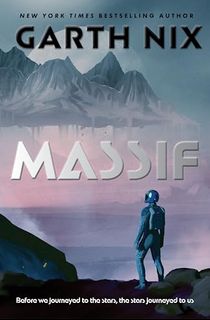
Massif
From New York Times bestseller and master of speculative fiction Garth Nix comes his first foray into adult science fiction with a brilliant and poignant stand-alone story of sentient starships, galactic warfare, and the bonds a crew forms far, far from Earth.
In your acknowledgements, you mentioned your own military history. Did you know you were going to focus on military aspects from the start and how important was it to get the militaristic details accurate?
I think it is very important in everything I write that it feels real. And I think one of the ways to do that is with small details that build up to create that illusion of reality.
When it comes to something like a military organization, there are a lot of people who've had some form of military experience, and so anything that feels wrong to them will jar and put them out of the story. There're also a lot of people who've seen and read about the military. I think people have an instinct for stuff that feels real. So certainly, I wanted it to feel like the characters were part of a real military organization, with all its flaws and problems.
One of the things I was trying to do is show the ordinary life out of combat. I mean, there's a lot of military science fiction that is very combat-focused, and there is some of that in Massif. But I also wanted to show the day-to-day stuff and those challenges.
So yes, I did draw upon when I was a part-time soldier. I was an Army Reservist, in an Assault Pioneer Platoon. I joined when I was 17, left when I was 21, and it was a very formative experience that I've drawn on in a lot in different parts of my writing.
All of the best military fiction is usually written by people who've experienced it, and it’s often about the ordinary day-to-day stuff interspersed with those violent moments of combat. Which speaks to the whole military experience; a lot of waiting around and boredom and mundane activities interspersed with terror. So, I was trying to capture that. It's odd to say I’m writing a story about the crew of a small ship somewhere far out in the galaxy on a sentient mountain range that is transporting them between star systems, and that I want to make it authentic. But I do. I want to make it real.
JB: What surprised you the most when you were writing this novel?
GN: It's kind of an unpleasant surprise. I write short science fiction more often than an entire novel. In my other science fiction novels, I didn’t really have to work out how the technology interacted and worked. But for Massif, one of the early choices I made was that the Massifs don't let the humans have any technology that's post-World War II. So, they give them these interplanetary spaceships called BASICS, which humans have to fit out. They have an inertia-less drive, and they can go anywhere, and they're impervious to human weapons. But the Massifs don’t let them use anything modern because they don't want humans to work out what's going on with the Massifs.
So, I made this decision. I thought it was cool that they've got these hulls, which are super advanced, and have their own drive system, which they don't understand, but they can direct. But everything else, all the electronics and so on, are all valve-based. But once I made that decision, I then had to do a lot more research than I normally do. I had to work out things like tube-based radar and how would the radio work. All that sort of stuff. I had to do a lot more research and ask people about how things actually work. But it was fun.
A lot of your books tend to be series, while Massif was advertised as a standalone. Was your approach different than when you tackle a series?
Quite often, I intend a book to be a standalone. When I start, I think of it as a single story. But I seem to instinctively leave it open to be more, so that I can come back. And I think part of it is that comes back to making the world feel real. Because I do really want to make the world feel real, that makes it possible to tell more stories. Once you've built the foundation, there's usually room to come back and do more things.
I wrote Massif as a standalone. At the moment, I think it's a standalone. But I can't say I won't come back to that world and write more, because I think there certainly is potential for more stories in that world.
Anything's possible. Never say never again.
I just have one more question, what's next for you?
I've recently turned in my next Bookseller book, which is The Even-Handed Booksellers of Edinburgh, which will be out next year. Interestingly, in fact, in America, The Left-Handed Booksellers of London and The Sinister Booksellers of Bath, which were originally published as YA, are going to be re-released as adult fantasy. But of course, they're all the same. Nothing's changed.
After that, at the moment I’m writing a YA coming-of-age story with a teenage protagonist. It’s a high fantasy. I wanted to write a book with elves and dwarves and dragons. As a huge Tolkien fan, I’ve long wanted to do something in that space. It hasn’t been announced, so I can’t tell you the title yet, but that’s what I’m working on at the moment.


